


CCAS Professor Receives Simons Foundation Grant
Gabriela Rosenblau, GW associate professor, received funding to support undergraduate research opportunities in neuroscience.

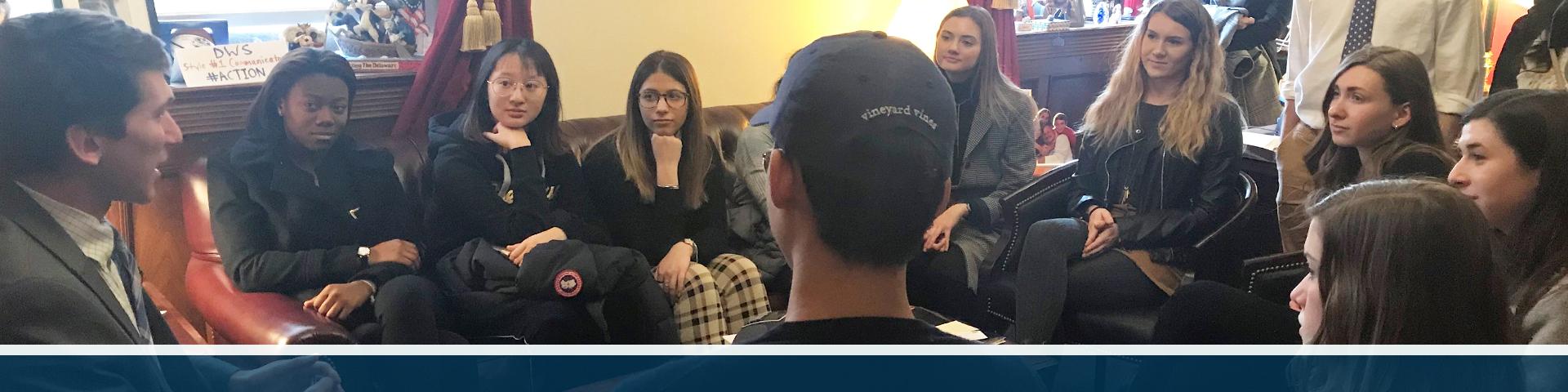
Students in the Department of Psychological and Brain Sciences learn to apply psychological theories and methods to solve urgent problems facing individuals, communities and society. Our faculty members are active in mentoring student research, and several have been recognized for their prolific contributions to their fields of study.
Surrounded by the esteemed research and health centers that Washington, D.C., and GW have to offer, psychology students integrate practical experience and research into their coursework, preparing them for a wide range of successful careers.
The mission of the Department of Psychological and Brain Sciences at the George Washington University is to contribute to psychological knowledge and educate undergraduate and graduate students. Our aim is to provide a solid foundation in scientific approaches, psychological theory and education and training in both basic and applied aspects of psychological and brain sciences. Central to this mission is a scientist/practitioner model that emphasizes the development of proficiency in theoretically grounded research and quantitative and qualitative methods to: (1) elucidate cognitive, neural and affective mechanisms as well as social and structural factors driving behavior; (2) advance empirical knowledge about mental and physical health and well-being; and (3) reduce health and social inequities. Our location in Washington, D.C., is ideally suited to our mission.
Our proximity to many of the nation’s leading research institutes and organizations — such as the National Institutes of Health and the National Science Foundation, as well as numerous other nonprofits, think tanks, policy organizations and applied research units — creates opportunities for students to enhance their academic and professional development and training beyond the classroom.
Through our teaching, research and service, we aim to make the world a healthy and equitable place, beginning with our own community. We aim to foster an academic climate that is diverse, equitable and inclusive for all students, faculty and staff. Our goal is to seamlessly infuse these values throughout all aspects of our department, including but not limited to student admissions; faculty hiring, tenure and promotion; academic program curricula and teaching; student and faculty scholarship and research; and department-sponsored programs and events.

CCAS Professor Receives Simons Foundation Grant
Gabriela Rosenblau, GW associate professor, received funding to support undergraduate research opportunities in neuroscience.

Psychology and Cinema: Inside a Cannes Classroom
A one-of-a-kind study abroad course by professional psychology’s Katherine Marshall Woods brought students inside the Cannes Film Festival to explore the science behind storytelling.

CCAS Researchers Uncover Autism Insights
A study led by Cognitive Neuroscience Professor Gabriela Rosenblau presents new understandings of how autistic and non-autistic people learn about each other.

GW Serves: Finding Purpose in the Classroom
Senior Mackenzie Campbell-Gill, a psychology major and sociology minor, discovered confidence and a passion for helping others while tutoring D.C. students.

Student Research Takes Center Stage at CCAS Showcase
More than 250 undergraduate and graduate students across disciplines displayed their scholarly work at the fourth-annual CCAS Research Showcase, including senior psychological and brain sciences...

Bouchet Society Students Honored for Research, Advocacy
Nine Ph.D. students will join a network of scholars from across the country this spring when they are inducted into the Edward Alexander Bouchet Graduate Honor Society.

Understanding Behavioral Development
In a video conversation with CCAS Dean Paul Wahlbeck, Professor Rosenblau discusses how social cognition develops in childhood, particularly for those with autism.

Into the Fire: Researcher, Firefighters Team on Life-Saving Searches
Psychology’s John Philbeck is taking his spatial cognition research out of the lab and into action to aid search and rescue squads.

Outside-In: Psychology Major Rafael Castro Redefines the Modern Big Man
Once a guard, GW’s preseason All-A-10 star brings versatility, poise and belief to a team that kicks off a highly anticipated season Saturday against Georgetown.
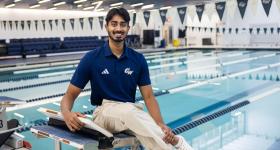
Champion Swimmer Dives into Nutrition Platform
Senior psychology major and A-10 champion swimmer Ganesh Sivaramakrishnan launched PowerPlatez, an app designed to help busy people eat smarter while saving time and money.